Digital Exclusives

World-Class Bone Marrow
Transplants, Close to Home

February 11, 2026

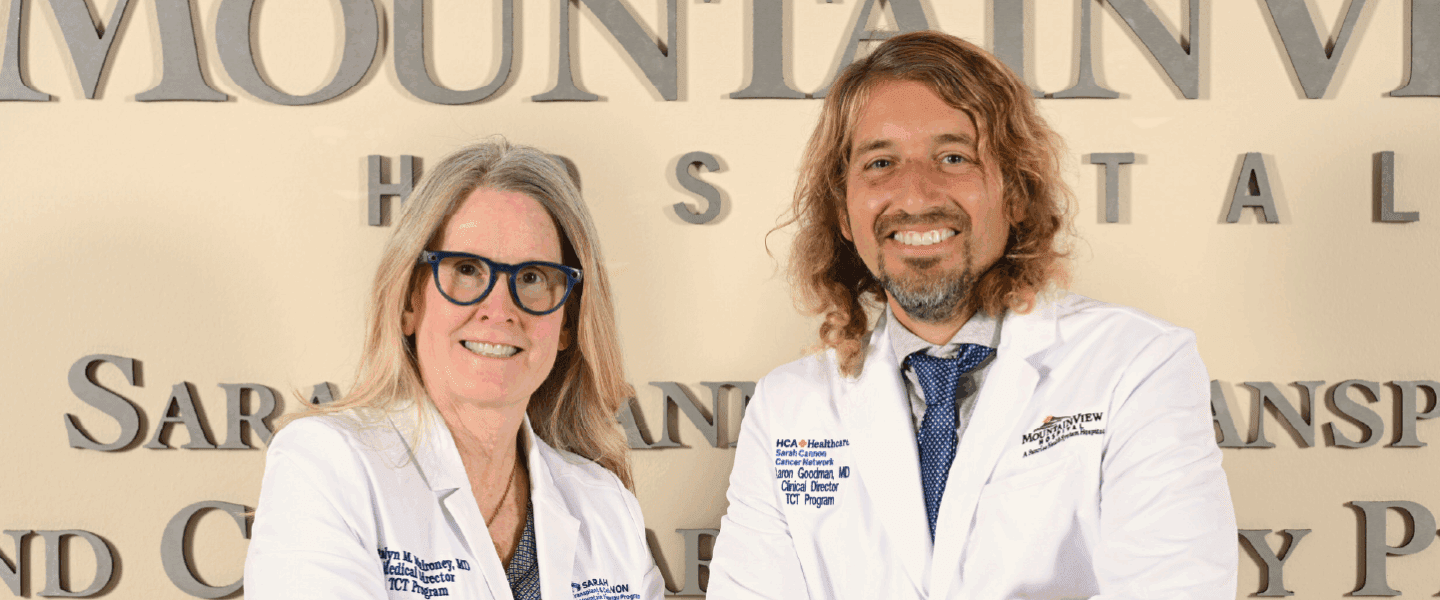
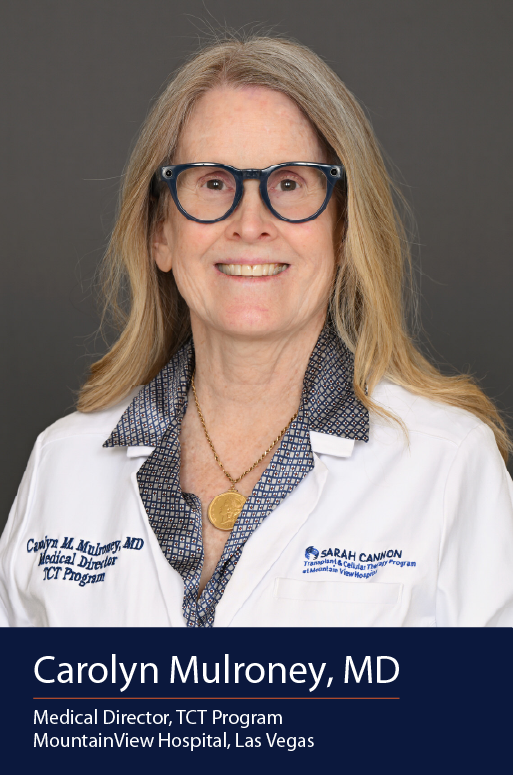
Carolyn Mulroney, MD, has walked hundreds of patients through the most devastating news of their lives. The renowned oncologist helped launch Nevada’s first bone marrow allogeneic transplant program at MountainView Hospital in Las Vegas and understands the crushing decisions patients face when they process a blood cancer diagnosis.

Prior to the opening of the Sarah Cannon Transplant and Cellular Therapy Program at MountainView, Nevada, blood cancer patients also faced a logistical nightmare: where and how to travel for the care they needed. “Treatments can take a minimum of three to six months,” Dr. Mulroney says. Lengthy, intensive hospital visits required people to uproot themselves and their families to another state or to invest in long-term hotel stays without the care of loved ones close by.

“The most heartbreaking part was the hundreds of patients going untreated because it was just too much to travel for care that could have saved their lives,” adds Maria Rios, the program’s administrative director. “Allowing patients to stay at home — and allowing their families to continue their lives here — has been monumental.”
Treatment Options

When MountainView’s Sarah Cannon Transplant and Cellular Therapy Program opened in 2021, it offered patients a type of bone marrow transplant called autologous stem cell transplants.

“Autos” start with the collection of the patient’s own stem cells. After the patient undergoes high doses of chemotherapy to kill cancer cells, the preserved stem cells are infused into the patient’s bloodstream. Through an engraftment process, the cells travel to the bone marrow, where they begin creating new blood cells.

In 2024, Dr. Mulroney came on board from the University of California-San Diego to help round out the center with two additional world-class blood cancer treatments: allogeneic transplants and CAR-T cell therapy treatments.

Allogeneic transplants start with chemotherapy before receiving an infusion of stem cells from a donor. “We collect donor cells from all over the world and transport them to a processing lab where the cells are adjusted,” says Dr. Mulroney. These cells are delivered to MountainView, where the patient receives the infusion.

While the most intensive part of recovery occurs during the three weeks after transplant, when the patient is still in the hospital, that’s just the beginning of the recovery process, she explains.

“You can’t give somebody a whole new immune system and then send them on their way. It’s a process — that’s why you really need access to their community and their support system.”

You can’t give somebody a whole new immune system and then send them on their way. It’s a process — that’s why you really need access to their community and their support system.

— Carolyn Mulroney, MD, Medical Director, TCT Program, MountainView Hospital, Las Vegas

During those recovery months, patients come in three days a week for doctors to evaluate how they’re tolerating the transplant and to ensure their immune system is developing appropriately.

Through CAR-T cell therapy, a type of immunotherapy, the patient’s blood is processed, and T cells are collected. These collected T cells are sent to a lab, where a new gene is inserted into the T cells to create a receptor called a chimeric antigen receptor (CAR). After the new CAR-T cells expand to a therapeutic dose, they are infused back into the bloodstream, where they multiply and destroy cancer cells.

Comprehensive Care

When MountainView Hospital doctors conducted their 100th bone marrow transplant in late December 2025, the allogenic transplant was performed from the hospital’s dedicated Oncology floor.

“Reaching our 100th transplant is a significant milestone and powerful reminder of why this program was created,” says MountainView Hospital Chief Executive Officer Alexis Mussi. “Patients no longer have to travel out of state for highly complex, life-saving blood cancer care. They can now receive world-class treatment close to home, surrounded by their families and support systems.”

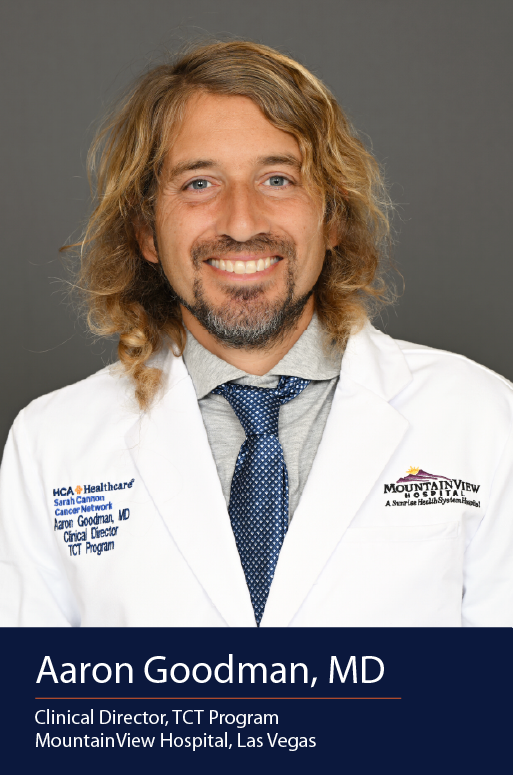
The patient was one of more than 300 referrals Dr. Mulroney and her colleague, Aaron Goodman, MD, received this year — up from 84 referrals, a 275-percent increase from the year before. Dr. Goodman, board-certified hematologist and medical oncologist with MountainView Hospital, recognizes the significance of these outcomes for the community.

“While blood marrow transplants are pretty standardized across most centers, what makes us unique is that we are literally the only center in the state of Nevada that offers allogeneic transplant and CAR-T therapy,” says Dr. Goodman. “These are lifesaving therapeutics for very aggressive hematologic (blood) cancers and bone marrow failure syndromes.”

As the largest provider for blood cancer patients, HCA Healthcare’s Sarah Cannon Network offers a “One Comprehensive Approach” to patient care. “That means we follow one standardized approach to care by utilizing the latest and greatest research and treatment outcomes,” says Regional Vice President of Oncology Services for HCA Healthcare – Far West Division Tom Cronin.

MountainView Hospital is one of Sarah Cannon Network’s 10 blood transplant programs across the United States and the United Kingdom. “If you combine them, that’s more than 1,600 patients annually,” Cronin says.

Clinical Trials

Sometimes even the most cutting-edge treatments aren’t enough. That’s when doctors look to clinical trials for hope. “Trials vary from one institution to the next, and we’re very good at making decisions about whether patients should be enrolled,” says Dr. Mulroney.

When Sarah Cannon Research Institute opens its clinical trials division at MountainView in 2026, patients will have even more comprehensive access to blood cancer treatments.

“Sarah Cannon Network was one of the major enrollers in clinical trials for some of the Car-T cell therapies that led to the FDA approval,” says Dr. Mulroney. “The type of support we have enables us to offer a broad range of clinical trials that can be difficult to get at a single institution.”

The type of support we have enables us to offer a broad range of clinical trials that can be difficult to get at a single institution.

— Carolyn Mulroney, MD, Medical Director, TCT Program, MountainView Hospital, Las Vegas


A highly coordinated patient experience is made possible by collaboration and partnerships. In addition to investments in clinical trials, HCA Healthcare is also investing in new technologies, such as advanced navigational robotic bronchoscope systems for diagnosing lung cancers and state-of-the-art minimally invasive platforms for treating solid tumors.

“Many times, clinical trials are the best treatment option for a patient,” says Dr. Goodman. “We will be offering numerous first-of-its-kind trials in BMT, cell therapy and novel immunotherapeutics. Patients have been very grateful. Many were ready to pack their bags and travel to another state for their treatment. The fact that they can remain locally with their family and support network is life-changing for these patients.  Imagine being diagnosed with an aggressive, life-threatening blood cancer and then being told you have to figure out and finance a way to leave the state, find local housing and receive treatment there.”

Dedicated Guidance

Cronin is also a board member of the Nevada Chapter of the American Cancer Society. He thinks of himself as a honeybee. “I go from resource to resource and help cross-pollinate everybody to get us all to work together,” he says.

Recently, Cronin had a personal experience that gave him an even greater appreciation for one of Sarah Cannon’s One Approach practices: the dedicated oncology nurse navigation program.

“I was in a room with my dad when he got a difficult health diagnosis, and everything the doctor said afterward was kind of gibberish,” Cronin remembers. “After patients hear the word ‘cancer,’ their minds often go to other places, and it’s hard to focus on the details or the next steps.”

That’s when a dedicated Sarah Cannon Oncology nurse navigator stepped in to help. Specifically trained nurses serve as anchors for support and information. They attend patient appointments and participate in multi-disciplinary meetings to remove barriers to care.

“If a patient wakes up in the middle of the night and has a question or a concern, they can message their nurse navigator,” Cronin says. “The nurse navigator can help triage all of the cancer patients’ needs.”  This is a nationally recognized program that I am so proud to support.”