At the heart of innovation is a desire for improvement. Better outcomes. Better working conditions. Better results in every facet of patient care.
At HCA Healthcare, our commitment to continuous improvement starts inside our Digital Transformation and Innovation (DT&I) and IT teams. To address ongoing documentation challenges, they’ve implemented game-changing solutions, including the introduction of MEDITECH’s Expanse electronic health record platform, the in-house development of the Nurse Handoff tool and an early screening discharge planning process.
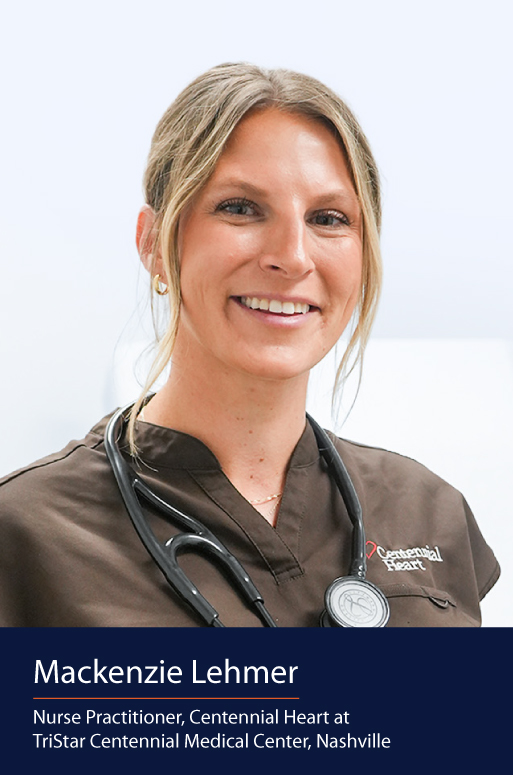
Combined, initiatives like these have solidified HCA Healthcare’s position as a leader in emerging technologies and digital innovation. Mackenzie Lehmer, a board-certified nurse practitioner at Centennial Heart at TriStar Centennial Medical Center in Nashville, appreciates technology that removes barriers so she can spend time where it really matters — caring for patients, talking to patients more and being able to share compassion.
“We didn’t sign up to be in healthcare just to chart,” says Mackenzie. “We signed up to take care of people. Because we care. That defines really good healthcare.”
MEDITECH Expanse
Jake O’Shea, MD, vice president and chief health informatics officer of the DT&I Expanse team, considers a facility’s electronic health record to be “the operating system of the hospital,” detailing physician orders and other key documentation and disseminating that information to relevant care teams. As the enterprise’s operating system, MEDITECH’s cloud-based Expanse platform is the foundational technology that facilitates workflows. Not only does it improve the coordination of care for patients, but it also gives nurses quick access to patient information on the go via mobile devices.
MEDITECH Magic, the legacy platform, had been reliable, but its text-based interface could be difficult for users of modern applications to adapt to.
“The Expanse experience unites the workflow for all users in a modernized view,” Dr. O’Shea says. “It streamlines and improves care coordination. It also enhances the availability of information at the point of care.”
Dr. O’Shea appreciates HCA Healthcare’s ability to standardize the Expanse experience, which means end users have consistency across facilities. “This gives us the opportunity to reduce unwarranted variations in care, which research shows leads to improved outcomes, and ensures that our data structures are standardized.”
The Expanse implementation began in January 2023, with a pilot at three New Hampshire facilities. The pilot produced promising feedback.
“Our Expanse program started with a goal of creating a repeatable, scalable implementation process that minimizes the impact of that change so that our caregivers can focus as much as possible on the patients in front of them,” says Dr. O’Shea, who serves as the executive sponsor
for Expanse.

“In February 2024, a second pilot group in North Central Florida helped us better understand what it would take to implement Expanse in a repeatable fashion across our enterprise,” he says. Last year, HCA Healthcare transitioned to a broader “wave-based” rollout model, which brings groups of facilities live every two to three months.
TriStar’s Mackenzie Lehmer believes one of the essential elements of her job is ensuring that patients and their families feel comfortable and understand what she’s doing and why.
“The most meaningful thing that I do is make vital connections with patients and their families,” says Mackenzie. “So, any technology that increases my throughput and allows me to be able to spend more quality time with those people that we’re taking care of is invaluable.”
Throughout the rollout, Expanse’s capabilities have exceeded her expectations.
“As nurse practitioners, we’re almost translators in a sense. We take what the doctor wants to do, we take what our plan is, and we put it together for these patients and these families,” says Mackenzie. “Being able to streamline my workflow to reduce time spent navigating charts and searching for labs allows me the efficiency to focus on patient safety — what really matters in patient care. That’s really what Expanse has allowed us to do.”
Noting that there can often be a natural resistance to new technologies, Mackenzie says the benefits of Expanse were readily apparent.
“I literally save so much time, probably five times more on documentation, just because I’m able to streamline that in a more efficient manner,to where I can now spend that time on the human side of care with patients and their families,” she says. “Expanse reduces the time I spend moving between systems. It gives me all the key information on one screen. It’s organized. It’s accessible. It gives you a summary page, so you can catch trends a little easier.”
I save so much time, probably five times more on documentation, I can now spend that time on the human side of care with patients and their families.— Mackenzie Lehmer, nurse practitioner, Centennial Heart at TriStar Centennial Medical Center, Nashville
DT&I plans to transition all HCA Healthcare facilities currently using MEDITECH electronic health records to Expanse by the end of 2028.
“We often talk about the importance of HCA Healthcare as a learning healthcare system, and the Expanse program reflects that commitment,” says Dr. O’Shea. “With each wave of sites, we improve our implementation processes with the goal of minimizing the disruption of implementation for our patients and caregivers.”
“We have developed repeatable processes. We continually assess and make advancements within the Expanse platform to improve workflows for our caregivers, facilitate delivery of innovative tools and enhance outcomes for our patients.”

Nurse Handoff
Nurses engage in one of the most critical moments of patient care: handing off patients from one nursing team to the next.
Historically, preparing for a handoff has required significant manual effort. Clinicians must review charts, synthesize the most critical details about the patient and their plan of care, and determine what to communicate. Because this process relies on individual judgment, it
can create variation and increase the risk of omitted information.
Nurse Handoff is a new tool that allows nurses to be mobile at the bedside and leverage AI to support summarizing key patient data. It gives nurses all the critical elements needed to communicate during a bedside shift report, helping them focus on caring for patients.
The Nurse Handoff concept originated from field feedback and research, which revealed an opportunity to use large language models, or LLMs, to support nursing operations and standardize the language used during the bedside shift report process. HCA Healthcare’s product development team worked with nurses across four facilities and three divisions, collecting more than 7,000 responses.

“The shift handoff process became significantly more efficient and streamlined,” says Gladys Dushane, ACNO, HCA Florida Lake Monroe Hospital. “Nurses were able to spend less time digging through the charts and having to recall details at the end of the shift. The AI handoff tool helped them organize all the necessary information in one place.”
The tool generates an automated shift report, including a consolidated summary of a patient’s encounter from admission to current date, and a timeline detailing the progression of care and significant events throughout a patient’s encounter. Further, the tool presents pertinent handoff data such as assessments, laboratory results and imaging.
“It’s just very easy for us. We aren’t going all over the place to find the answer. It’s very handy to use the app,” says Emelin Anfone, RN, Oncology, HCA Florida Osceola Hospital. “You find all the information that the patients or their family members wanted to know.”
The tool isn’t an off-the-shelf product. Nurse Handoff was developed for HCA Healthcare nurses by HCA Healthcare nurses.
“So many times, nurses are given tools that they use but never had any input on,” says Dushane. “To have a tool made for nurses, with nursing input, is so important.”
Sheila Demetrius, clinical nurse coordinator, Medical/Surgical, HCA Florida Osceola Hospital, acknowledges the new Nurse Handoff tool was “
a big improvement.”
“By using Nurse Handoff, you can see exactly why the patient is here, the admissions and any labs pending,” says Demetrius. “That definitely makes me more confident.”
In 2025, a study of the Nurse Handoff tool indicated an 83% reduction in safety events related to shift handoff and a 95% key performance indicator rating for factuality, coverage, coherence, conciseness and helpfulness.
“From my nurses’ and our patients’ perspective, the tool has provided a structured format for them to be well-organized and have information at the bedside,” says Yamile Der, nursing director, Oncology, HCA Florida Osceola Hospital. “It built trust between the patient and the nurse.”
To have a tool made for nurses, with nursing input, is so important.— Gladys Dushane, ACNO, HCA Florida Lake Monroe Hospital
Early screening discharge planning
HCA Healthcare continues to innovate its inpatient throughput discharge planning evaluations, or DPEs. In the past, case managers completed
DPEs for all patients, regardless of whether they actually required case-management intervention. While comprehensive, this time-consuming
process often resulted in lost time, distraction from other priorities, staffing challenges and staff dissatisfaction.
The proposed solution was to leverage a new regulatory-compliant screening tool to identify patients who needed DPEs, ensuring that case managers could prioritize the right patients at the right time while preparing discharge needs.
Now, by using predictive modeling in early screening, patients who require case management engagement are identified. The result is improved efficiency and time management for case management staff.
During trial runs at two HCA Healthcare Innovation Hubs, Florida Oak Hill Hospital and TriStar Hendersonville Medical Center in Tennessee, staff were able to lower the number of required DPEs from 557 to 404, reducing the number of DPEs completed from 74% to 54%, and saving
more than 25 hours of administrative time.
With every innovative step forward, HCA Healthcare continues to pair our people’s expertise with emerging tools and technology. Leveraging early screening processes, digital record keeping and nurse handoff solutions elevates the experience for those at the heart of what we do: our patients.